
Lapping Pitch
Gugolz® Lapping Pitch
Have you ever faced the frustration of a delicate optical component failing to meet its required wave-front accuracy due to “stiction,” uneven lap wear, or temperature instability? In the exacting world of high-end optics, even the slightest variance in the viscosity of your polishing medium can lead to surface irregularities that are impossible to correct in the final stages. Selecting the wrong grade of polishing pitch can make high-precision lap surfacing and pitch polishing feel ten times harder than necessary, leading to costly delays and compromised specifications. Fortunately, you don’t have to settle for anything less than perfection because Advanced Abrasives offers the world-renowned Gugolz® Lapping Pitch to ensure consistent, predictable results across every application.
At Advanced Abrasives, we leverage our comprehensive knowledge of conventional and superabrasives to help research labs and high-volume manufacturers achieve world-class optical surfaces. We understand that the pitch is not merely a carrier for the abrasive, but a critical technical component that determines the success of the polishing process. We encourage optical engineers and technicians to contact Advanced Abrasives today for competitive pricing or expert technical guidance on selecting the ideal Gugolz® pitch for your specific requirements.
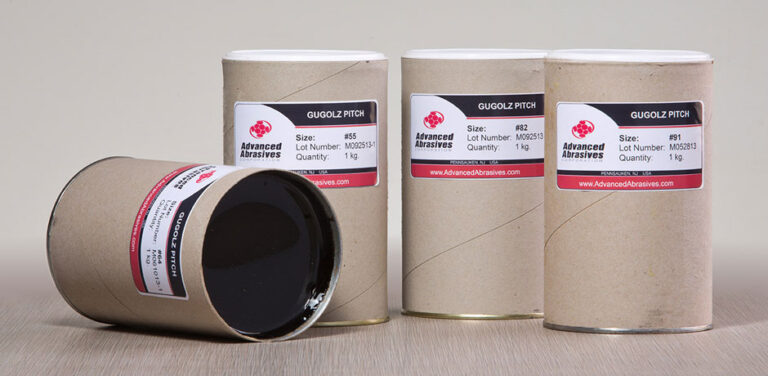
Identifying the Need for Superior Lapping Pitch
The performance of an optical polishing pitch is dynamic, influenced by friction, ambient temperature, and the specific abrasive slurry being utilized. Even the most skilled technician cannot compensate for a lap that has lost its viscoelastic properties. Recognizing the early warning signs that your lap needs to be re-pitched or that you require a different hardness grade of Gugolz® lapping pitch is essential for maintaining throughput and quality.
You may need to evaluate your current setup if you encounter any of the following issues:
- Excessive “Stiction” or Drag: If the optic begins to grab or chatter during the stroke, your pitch may be too soft for the current operating temperature, causing it to “flow” too quickly and lose the hydrodynamic film.
- Edge Dubbing or Rolloff: A lap that is too hard will not conform to the slight curvature changes of the optic, leading to poor figure control and unwanted edge effects.
- Rapid Pattern Degradation: If the facets or grooves in your lap close up too quickly, the pitch grade is likely too soft. In certain high-throughput environments, users may supplement their process by using lapping film to achieve more rigid, repeatable geometry.
- Sleeks and Surface Scratches: Old or contaminated pitch loses its ability to embed rogue particles. If you are experiencing high scratch counts during the initial prep stages, ensure your silicon carbide grinding papers are being used correctly to establish a clean, uniform surface before moving to the pitch lap.
- Temperature Sensitivity Issues: If your polishing results fluctuate between the morning and the afternoon, your current polishing pitch lacks the stability found in the Gugolz formulation.
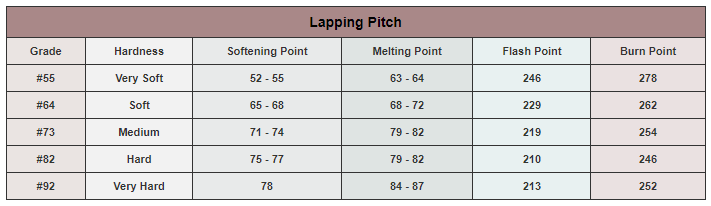
The Industry Standard: Why Professionals Choose Gugolz®
In the optics industry, Gugolz® Lapping Pitch is widely regarded as the premier choice for manufacturing precision lenses, mirrors, and prisms. The reputation of Gugolz® is built upon extreme purity and unmatched consistency. Unlike wood-rosin-based alternatives, which can vary significantly between batches, Gugolz® is a petroleum-based pitch that offers a predictable response to heat and pressure.
One of the primary reasons professionals insist on Gugolz® polishing pitch is the availability of five distinct, standardized hardness grades. This allows for surgical precision in process design:
- Grade 55 (Very Soft): Ideal for cold environments or very delicate, low-pressure polishing.
- Grade 64 (Soft): Frequently used for intermediate polishing stages where some flow is desired.
- Grade 73 (Medium): The “all-purpose” choice for standard laboratory conditions.
- Grade 82 (Hard): Preferred for high-precision flat work and maintaining tight figure control in warmer environments.
- Grade 91 (Very Hard): Specifically designed for high-speed polishing or environments with elevated ambient temperatures.
This granularity ensures that whether you are working on a 2-meter observatory mirror or a micro-lens for a medical endoscope, there is a Gugolz® pitch specifically engineered for the task.
Optimizing Your Polishing Workflow with Advanced Abrasives
Achieving a sub-angstrom finish requires more than just high-quality materials; it requires a deep understanding of how those materials interact. When you partner with Advanced Abrasives, we help you optimize your workflow by matching the lapping pitch hardness to your specific room temperature and material type.
The fundamental rule of pitch polishing is that the pitch must be soft enough to allow the abrasive particles to embed slightly, yet hard enough to maintain the geometric figure of the lap. While pitch is the ultimate medium for wave-front accuracy, many of our clients utilize specialized polishing cloths and pads for intermediate steps or high-speed commercial polishing where the absolute precision of pitch is not yet required.
Furthermore, we can advise on the “blending” technique. Many master opticians mix two grades of Gugolz® pitch (such as 73 and 82) to create a custom viscosity perfectly tuned to their facility’s HVAC capabilities. This level of customization is what separates standard manufacturing from world-class optical fabrication.
Frequently Asked Questions
Gugolz pitch softens and flows at relatively low temperatures, ensuring safe application. While specific melting points vary by grade, most technicians heat the pitch to between 50°C and 80°C (122°F to 176°F) to achieve a pourable consistency. It is critical to use a controlled heating element to avoid boiling the pitch, as bubbles can lead to lap failure.
Selection is primarily driven by the ambient temperature of your polishing room. If your facility is kept at a standard 20°C to 22°C (68°F to 72°F), Grade 73 is the traditional starting point. If your equipment generates significant heat, moving to Grade 82 may be necessary to maintain lap geometry.
Contamination is the enemy of the mirror finish. We recommend using dedicated melting pots for each grade of optical polishing pitch. Always ensure the lap base is thoroughly cleaned and degreased before pouring, and never mix old, used pitch with fresh Gugolz® material.
Yes. Whether you are using cerium oxide, aluminum oxide, or our high-purity diamond slurries, Gugolz provides an excellent substrate for suspending and embedding particles.
Secure Your Supply of Gugolz® Lapping Pitch Today
The success of your optical project depends on the reliability of your consumables. At Advanced Abrasives, we carry the full range of Gugolz® grades, ensuring that you have immediate access to the materials required for high-precision fabrication. We understand that in the photonics industry, downtime is not an option.
No matter the complexity of your optical project, be it astronomical, defense-related, or medical, we provide a solution that fits your budget, matches your technical environment, and performs reliably, batch after batch. We invite you to leverage our expertise and our robust supply chain to improve your yields and surface qualities.
Reach out to Advanced Abrasives today to secure your supply of Gugolz® Lapping Pitch or to speak with a specialist about optimizing your current polishing process. Let us provide the foundation for your next optical breakthrough.